
Efficacy
Can it work under ideal conditions?
RESEARCH & EVIDENCE
An evidence-based approach asks what blockchain can achieve, where it is useful, and how its outcomes compare with the alternatives.
Explore research, tutorials & case studies ↓BBA’s infographic summarises the global study by Naseem Naqvi and Mureed Hussain, including the quality of evidence and the PCIO assessment framework.
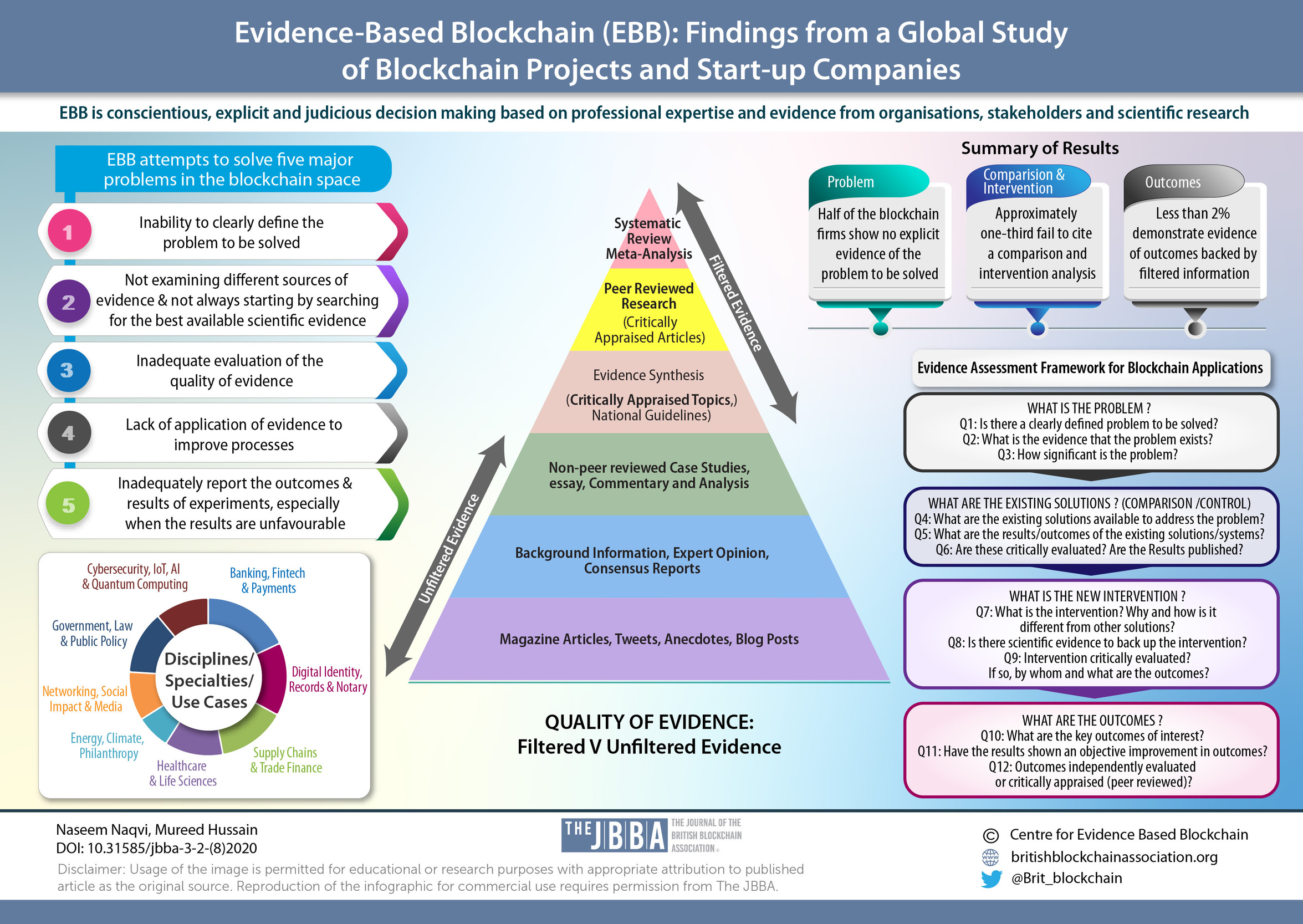
Structure an answerable question using Problem, Comparison, Intervention and Outcome. Then use the 5A’s to find, appraise and apply evidence, and assess what happens in practice.
Define the problem, who it affects and the needs the decision must address.
Explore →CIdentify the existing approach or alternative against which blockchain will be evaluated.
Explore →ISpecify the blockchain intervention and how it is intended to address the problem.
Explore →ODefine measurable outcomes and assess the benefits, costs and effects that matter.
Explore →FROM QUESTION TO PRACTICE
PCIO structures the question. The 5A’s guide how evidence informs the decision and how its results are evaluated.
Formulate an answerable question using the PCIO Framework.
Find the best available evidence from research, organisations, stakeholders and professional expertise.
Critically evaluate the evidence for quality, relevance and limitations.
Bring the evidence together with expertise and stakeholder needs to inform the decision.
Evaluate the results and the decision-making process, and use what you learn to improve practice.
FROM THE UK’S NATIONAL BLOCKCHAIN ROADMAP · JULY 2021
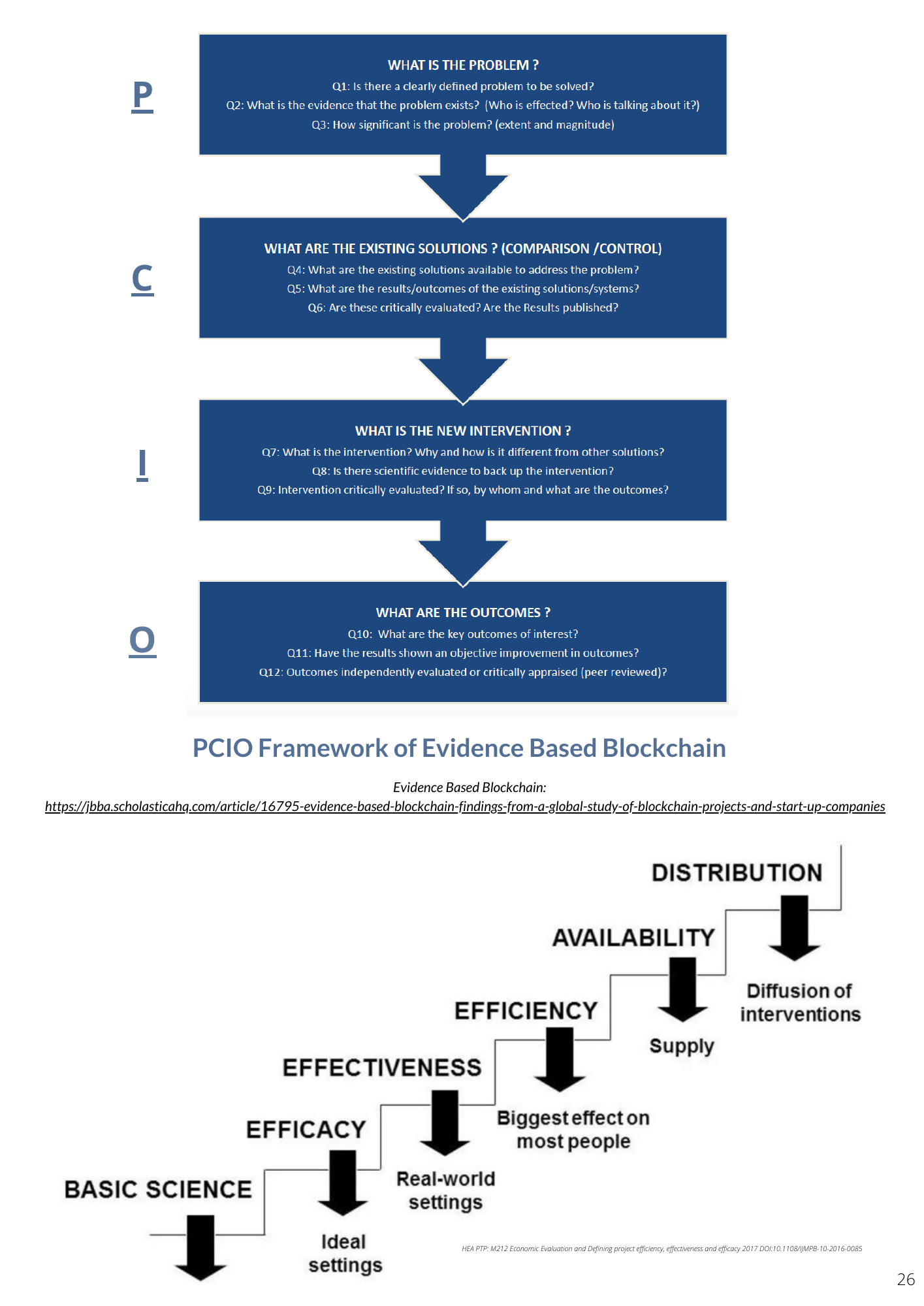
The Roadmap connects PCIO with regular evaluation of blockchain programmes. It asks three distinct questions: can an intervention work, does it work in practice, and is it worth the resources it requires?
Can it work under ideal conditions?
Does it work in real-world settings?
Is it worth it, considering the outcomes and resources used?
The Roadmap calls for regular audits of the societal impact of blockchain applications. Evaluate who benefits, what changes, and whether the intervention continues to serve its intended communities.
Its impact diagram spans enterprise and industry, public policy, society and culture, government and politics, health and quality of life, the environment, academia, and international activity.
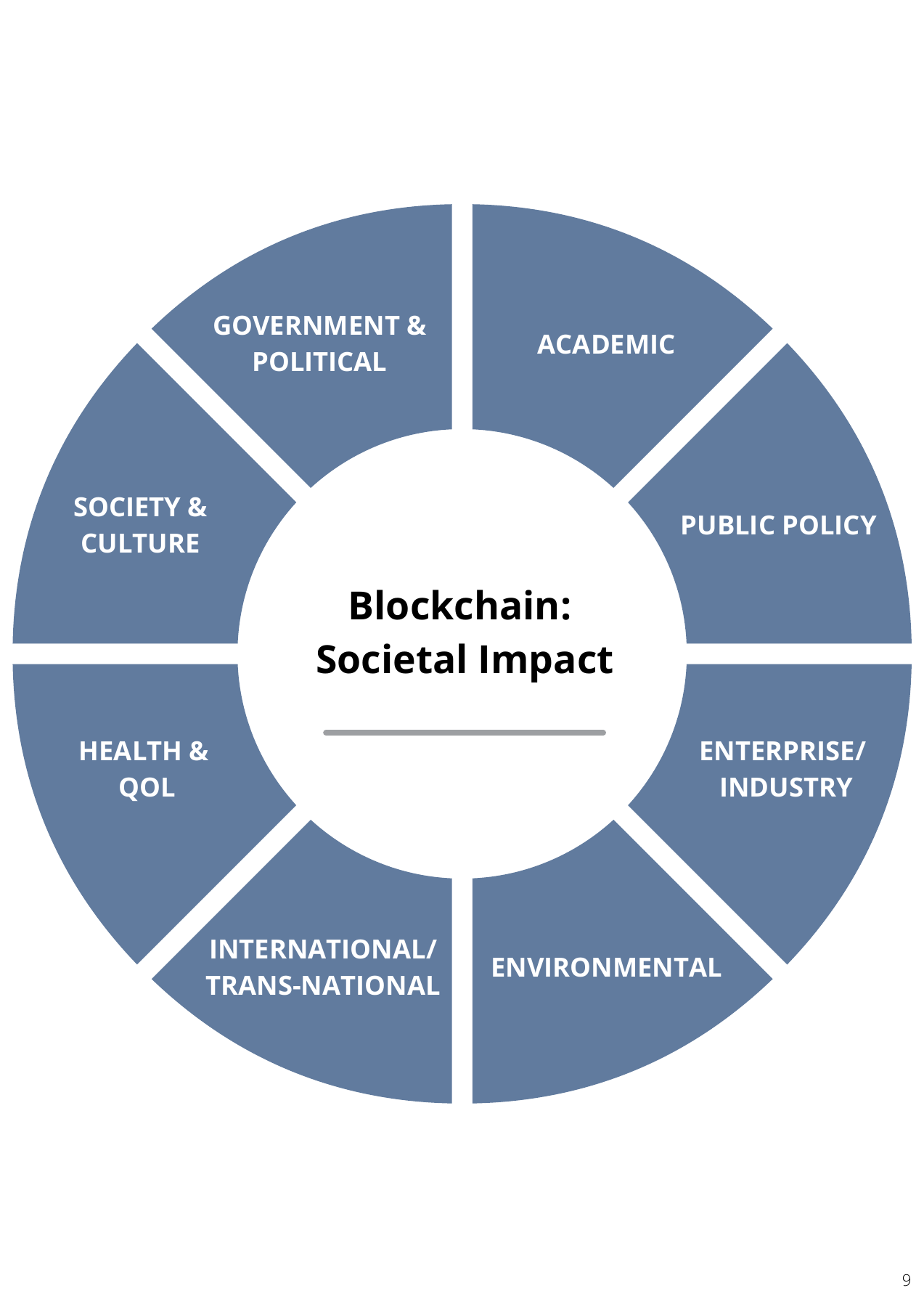
Source: BBA / CEBB, An Excellence Standards Framework for the UK’s National Blockchain Roadmap (Vision 2030), July 2021. Original figure credits are retained in the reproduced pages.
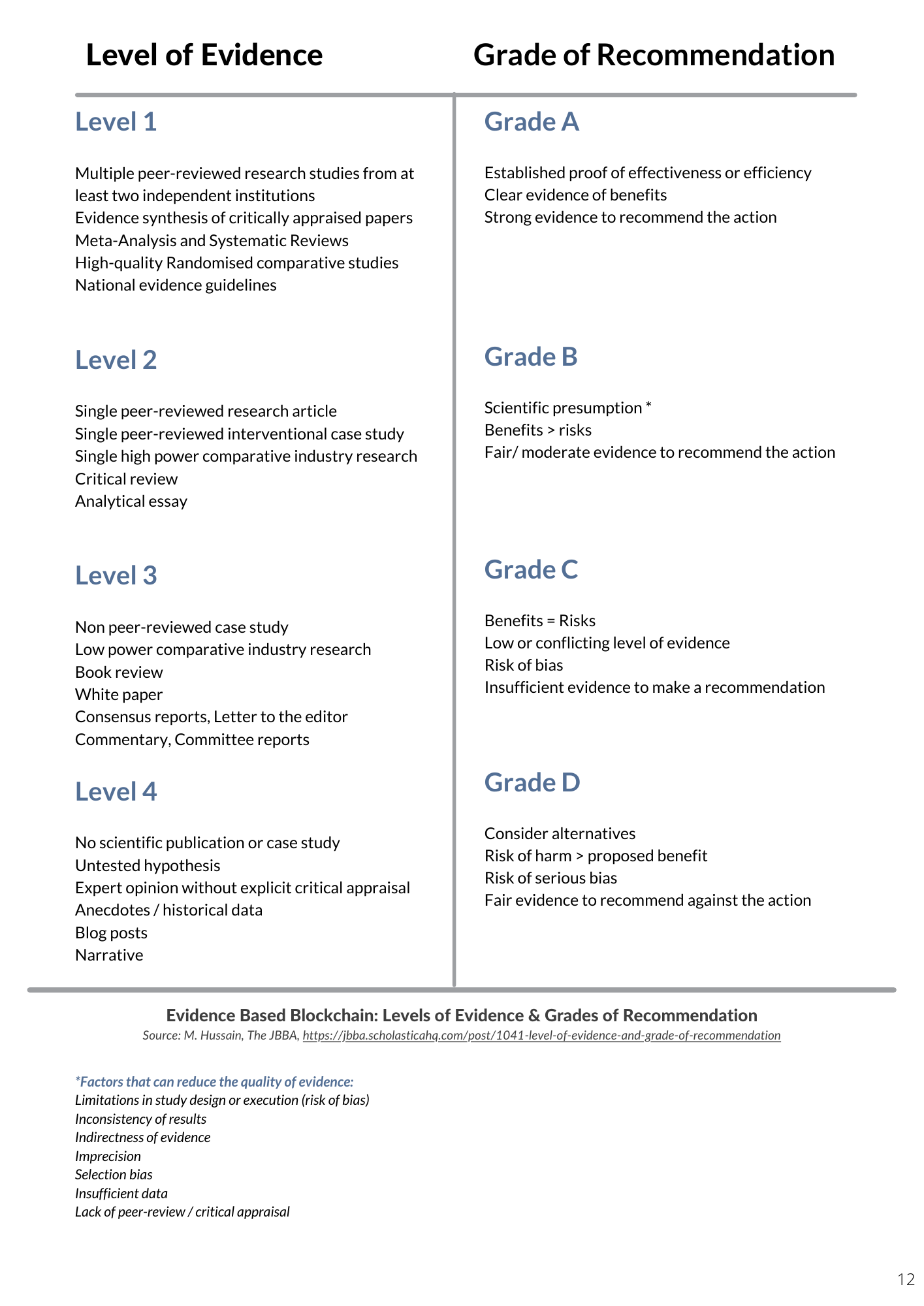
The Roadmap’s framework distinguishes the strength of the evidence from the recommendation made from it. These summaries sit alongside the original table and its full qualifications.
Grades A–D separately describe the basis for recommending an action, weighing evidence, benefits, risks and bias. A level of evidence should not be treated as an automatic recommendation grade.
Professor Naseem Naqvi distinguishes immediate activity and results from longer-term changes in people’s lives. The ambition is for work with demonstrated impact to become a Point of Reference (POR) for other people and organisations.
Source: Professor Naqvi’s explanation of outputs, outcomes, impact and Point of Reference ↗.
The Evidence-Based Blockchain library
Explore the work of Professor Naseem Naqvi and colleagues: original research, practical frameworks, teaching, published discussion and case studies. Follow the sources behind PCIO, the five As and the journey from evidence to societal impact.
Hannah Rudman’s “Piece of Cake” paper connects participatory action research with evidence-based DLT practice. It cites Naqvi and Hussain’s study and discusses PCIO. The CEBB infographic maps the approach to traceability and assurance of gluten-free oats.
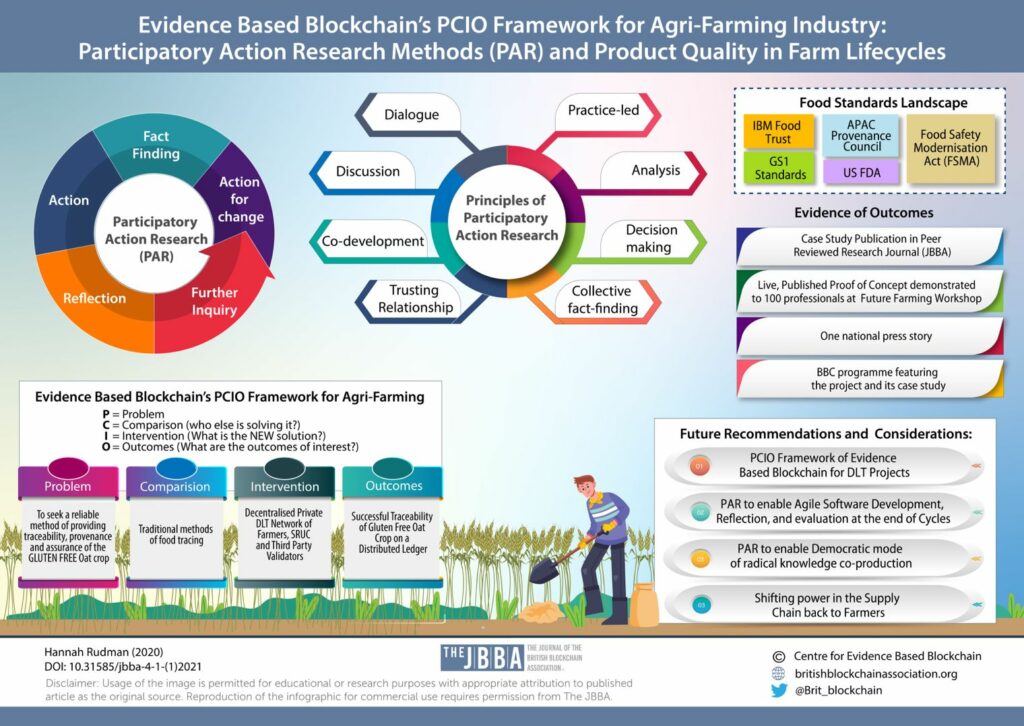
CEBB research summary of Hannah Rudman’s study. The infographic describes a proof of concept; readers should consult the paper for its methods, scope and limitations. DOI: 10.31585/jbba-4-1-(1)2021.
Dino Cataldo Dell’Accio and Mirko Montuori document the UN Joint Staff Pension Fund’s blockchain-based digital identity solution in the JBBA. Read the implementation paper alongside the BBA’s separate update on PCIO and its use at the UN.
The paper is the source for the implementation; the PCIO account is attributed to the BBA update. These sources do not imply UN-wide adoption or endorsement of the framework.
Start with the publications behind the approach, then explore its application to research, policy and public value.
The early editorial identified as the origin of Evidence-Based Blockchain in reference 8 of the 2020 foundational study.
Open source ↗The foundational evaluation of 517 firms, setting out PCIO, the five As and an assessment framework. Findings describe the study period, rather than today’s industry.
Open source ↗A companion reading on connecting research with the communities it is intended to serve.
Open source ↗Read the original diagrams and recommendations: societal impact on pages 8–9, evidence quality on page 12, and evaluation and PCIO on pages 25–26.
Open source ↗Why accessible research matters to policymakers, enterprises and society, and how open scholarship supports the translation of findings into practice.
Open source ↗The source cited by the Roadmap for its evidence-quality framework. Read alongside the separate Levels 1–4 and recommendation Grades A–D.
Open source ↗Naqvi draws on public-programme evaluation to make the case for evidence-informed blockchain policy. The post highlights randomised controlled trials and the importance of testing whether interventions deliver their intended outcomes.
Hear Professor Naseem Naqvi explain the questions, methods and judgement behind Evidence-Based Blockchain.
An extended introduction to PCIO, peer review, research quality and the National Blockchain Roadmap. Includes a readable transcript.
Open source ↗Ray Dogum’s interview with Naseem Naqvi explores comparison, outcomes, societal impact and research excellence. The author’s post links to the episode.
Open source ↗In his accompanying post of 26 January 2023, Naqvi highlights a priority for industry: “Evidence-based Blockchain > Consortium capabilities > Tech stack.”
View the original post and video ↗Follow the progression from inputs to outputs, outcomes, societal impact and work that becomes a point of reference for others.
Open source ↗A practical account of asking the right questions, running pilots, learning from implementation and improving interventions.
Open source ↗A discussion of scientific discipline, evidence quality and whether a proposed solution can work, does work and is worth pursuing.
Open source ↗A published account of Naqvi’s explanation of PCIO and the role of evidence in investment, development and implementation decisions.
Open source ↗These publications explicitly reference the foundational research or discuss Naqvi’s evidence-assessment approach. A citation shows scholarly use; it is not, by itself, proof of a successful deployment.
The lessons-learned section discusses Naqvi’s evidence-assessment approach and cites the 2020 Evidence-Based Blockchain study.
Open source ↗This white paper by Bonnie Lawlor, affiliated with the U.S. National Committee for IUPAC, and colleagues discusses Dr Naseem Naqvi’s Evidence Based Blockchain approach to evaluating potential blockchain applications. On page 305, it describes assessing the problem, proposed intervention, comparison with existing practice and evidence of outcomes. References 155–156 cite CEBB and the foundational JBBA study. BBA highlights this as a citation of its PCIO framework; the paper uses the ordering “PICO”.
Read the published paper ↗View BBA’s citation announcement ↗Examines educational credentials and the gap between promise and implementation. Includes Naqvi and Hussain’s 2020 study in its references.
Open source ↗A healthcare-management discussion whose bibliography cites the foundational Evidence-Based Blockchain study.
Open source ↗Evidence-Based Blockchain appears in books for enterprise innovators and practitioners. These two documented references show the approach reaching readers beyond the original research publications.
The book reproduces an evidence-quality pyramid credited to Naseem Naqvi and Mureed Hussain’s Evidence-Based Blockchain study. Its contents list “An evidence-based approach” in Chapter 8, Discovery Part Two, beginning on page 136.
Naqvi’s post of 23 July 2023 shows the book and the printed source credit—an example of the research informing guidance for enterprise innovators.
ISBN 9781781336427. The free sample includes the contents and Chapter 3; the photographed passage documents the EBB attribution.
Page 396 explicitly discusses Evidence-Based Blockchain, defining the approach and making the case for evidence-informed decisions in applied blockchain. The passage connects professional expertise with organisational, stakeholder and scientific evidence, and highlights its relevance to business practice.
Explore the book ↗Source photograph: Naseem Naqvi’s post of 10 February 2024, showing page 396 and the book cover.
Initiatives connecting researchers with the Centre for Evidence-Based Blockchain.
Ahead of the sixth Blockchain International Scientific Conference, BBA announced a one-year complimentary membership of its Centre for Evidence-Based Blockchain for MSc and PhD researchers attending ISC2024. The initiative illustrates BBA’s work to connect postgraduate researchers with the evidence-based blockchain community.
Read BBA’s original announcement ↗Historical initiative associated with ISC2024. The original announcement sets out eligibility; this entry does not advertise a current membership offer.
Explore the wider publication record and visual research collection.
Selected source material reviewed September 2026. Dates and findings belong to the original publications. Some external platforms require sign-in; publisher access conditions may vary.